Tag: costa concordia

  • Francesco Schettino, Captain of Costa Concordia, Found Guilty of Manslaughter

    Francesco Schettino, Captain of Costa Concordia, Found Guilty of Manslaughter

    A little over three years ago, the Costa Concordia struck rocks off the Italian island of Giglio, initiating a massive shipwreck that killed 32 people and led to the largest salvation of its kind in maritime history. The captain of the Costa Concordia, Francesco Schettino, was found guilty of causing this disaster by an Italian court on Wednesday. He was also found guilty of 32 counts of manslaughter and of abandoning ship. He was sentenced to 16 years: 10 years for the manslaughter charges, five years for causing the wreck, and one year for abandoning the sinking vessel.

    That Schettino is in some sense responsible for the wreck has never really been in dispute. As the captain, he was at the helm of the ship when it crashed, and the wreck was only made possible by Schettino’s decision to take the vessel off course so that it could sail closer to Giglio’s shoreline. The trial therefore hinged on the precise extent to which Schettino was responsible for the shipwreck – was he a “reckless idiot” who sailed the ship too close to shore in an act of misguided bravado, as the prosecutors argued, or was the wreck the fault of multiple people who failed to maneuver the ship in accordance with the captain’s wishes, as the defense had it?

    There were also a number of questions related to the degree of blame that could be assigned to Schettino for the passengers’ deaths. Even if he was solely responsible for the shipwreck, it nevertheless remains true that no one died on impact. Thus, the 32 deaths were most directly the result of a failed evacuation, and it is not clear how much responsibility a single person can bear, even if that person is the ship’s captain, for the evacuation of a ship carrying 4,252 people. However, Schettino’s actions certainly came across badly as the vessel was sinking. First of all, he abandoned ship before anywhere near all the passengers were off the Concordia. He should have been coordinating rescue operations from on board, attempting to discern exactly who remained on the vessel and was in need of rescue. The transcript recording the conversation between Schettino and the Italian Coast Guard after he had abandoned ship certainly paints the captain in a very poor light.

    Recognizing the complexity of assigning blame, the court did not give Schettino the 26-year jail sentence that the prosecutors had sought. Also, Schettino was not the only one punished for his involvement in the wreck. Five other employees, including the helmsman, were sentenced to jail for periods ranging from a year and a half to nearly three years.

    Through an appeal, Schettino might be able to shorten his jail sentence, and this legal process may drag on for a while. However, with the ship successfully recovered and taken to Genoa for scrapping, and with the main trial of the captain complete, the Costa Concordia story has for the most part come to a close.
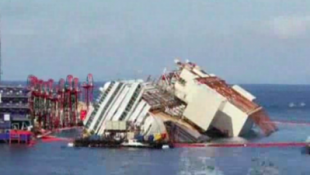
  • Costa Concordia Saga Ends with Docking in Genoa

    Costa Concordia Saga Ends with Docking in Genoa

    The Costco Concordia has completed its last voyage. After two years of laborious and highly technical work, the Costco Concordia salvage operation finally reached its end when the ship was pulled into the port of Genoa yesterday morning. The once-elegant cruise ship, which had 13 decks and could accommodate 3,780 passengers, will be scrapped. The memory of the disaster and its long aftermath will start to fade as the ship disappears piece by piece.

    The immediate cause of the ship’s arrival in Genoa is the refloating operation that began a little more than a week ago. The ship was successfully raised about 40 feet from its underwater resting position, allowing the vessel to be pulled by tugboats to Genoa. However, a salvation effort has been underway essentially since rescue operations ceased. It was the largest salvation of its kind in maritime history, involving several difficult and hazardous phases, like the parbuckling operation last fall, which brought the ship to an upright position.

    Although the refloating of the ship largely marked the end of the salvation operation, the ship still needed to remain in one piece on its four-day journey back to Genoa. The trip covered 170 miles (280 kilometers), and there were fears that the hull couldn’t withstand the stresses imposed by the voyage. This was particularly concerning because the ship had to be pulled through a marine sanctuary, where a disintegrating ship could cause immediate, large-scale problems. Nothing of the sort happened, and even if it had the Costa Concordia was accompanied by an envoy of vessels designed to deal with basically any problem. No more chances were to be taken with the Costa Concordia – it had wrought enough destruction.

    Although a major chapter of the Costa Concordia story has closed, there is still one major loose end: the fate of the ship’s captain, Francesco Schettino, who is currently on trial for his role in the shipwreck. However, at least the ship itself, which could have ended up as a grim and environmentally dangerous tourist attraction off of the coast of Giglio, is finally taken care of, and that’s a large point of resolution.

  • Costa Concordia Refloating Underway

    Costa Concordia Refloating Underway

    The seemingly never-ending story of the Costco Concordia might finally be near its conclusion, or at least the part that involves the ship itself. (The trial of Costa Concordia captain Francesco Schettino will continue to capture headlines for the foreseeable future.) The refloating of the Costa Concordia is well underway at this point, and has gone for the most part without incident so far. Below we have compiled all the important updates about the refloating of the Costco Concordia, as well as take a look at what will come next.

    The refloating of the Concordia began on Monday, when the ship was successfully lifted from the underwater platforms it has been resting on since the vessel was parbuckled in September. (For more on this interesting process, check out our explanation of parbuckling, written with reference to the Costo Concordia.) On the first day of the refloating operation, the ship was raised about seven feet; however, it needs to raised nearly 40 feet in total, a process that is expected to take about a week. So, over the next several days the vessel will be slowly brought to a floating position, and then Monday (or thereabout) the ship will be dragged away to Genoa, where it will be dismantled for scrape. (Despite being underwater for more than two years, some parts of the ship are still surprisingly intact and preserved.)

    The process of refloating the ship, one component of the largest salvation operation in maritime history, is complex. At the beginning of the undertaking, large tanks that are on the side of the vessel were filled with water, which lifted the ship from its resting position. Chains and cables are now being attached to the ship to help with the floating process. The operation is delicate, in large part because the ship’s hull could crack during the process, which could spill toxins and other debris into the surrounding waters. To help manage the difficulty of the task and monitor its progress, seven robotic submarines have been deployed. The one setback of the operation so far is that one of these submarines, known as ROVs (Remote Operated Vehicles), has been lost below the ship, potentially crushed by one of the chains securing the vessel, according to the Telegraph. Apart from this, the operation is going smoothly.

    Of course, more issues could be encountered over the next several days, and even once it is successfully refloated, it still needs to be pulled to Genoa. En route, some part of the ship could come apart, which is particularly worrying because the Concordia must pass through a marine sanctuary. However, the cruise ship will be part of a large convoy of vessels that will be equipped to deal with essentially any problem, so robust precautionary measures are in place to prevent the Concordia from causing any more damage. So far, so good, though, and hopefully the ship will safely make its way to the scrapyard where it can be taken apart and eventually forgotten.

  • Costa Concordia Captain Visits Wrecked Ship

    Costa Concordia Captain Visits Wrecked Ship

    For the first time since the cruise ship slammed into rocks off the coast of Isola del Giglio, Italy, a disaster that claimed 32 lives, the captain of the Costa Concordia, Francesco Schettino, climbed aboard the vessel yesterday with a team of experts. The experts where appointed by the court to determine if the Costa Concordia wreck was caused by anything other than human error, and Schettino accompanied them at the request of his attorneys.

    Schettino is currently on trial in Italy and is facing multiple charges, including manslaughter and abandoning ship. It is of course an open question to be determined by the court whether Schettino is responsible for shipwreck, but certain facts seem to work against his defense. His decision to steer the ship off its automatic course to salute the inhabitants of Isola del Giglio obviously precipitated the disaster, and it is indisputable that he abandoned the ship before every passenger was off, as a transcript of the emergency call between the Italian coast guard and Schettino that took place right after the wreck shows.

    On the other hand, a captain is not exclusively responsible for the physical movements of a cruise ship – moving a large vessel depends on multiple people – and it is still unclear what the crisis center staff told Schettino as the ship was sinking. No one died when the vessel hit the rocks, so the 32 deaths technically resulted from a failed evacuation, and this could shift some of the blame to the first responders. There are also questions about the failings of the ship itself – Schettino has noted that the vessel’s watertight doors malfunctioned, letting more water into the ship – and of course this is exactly why the team of experts recently surveyed the wrecked Costa Concordia.

    The captain was able to board the ship thanks to a parbuckling operation that took place a few months ago. By harnessing leverage, the massive sunken ship was raised, or rotated to an upright position. Currently, it sits atop underwater platforms right outside Giglio’s port.

  • What is Parbuckling? With Special Reference to the Costa Concordia Recovery Operation

    Parbuckling is the process by which a sunken vessel is rotated to an upright position by harnessing leverage. An instance of parbuckling is called a parbuckle salvage for obvious reasons: a ship is parbuckled so that it may be salvaged. This may appear to be an esoteric topic of concern only to engineers, which is essentially true, but parbuckling came to the attention of a larger audience with the raising of the Costa Concordia, the cruise ship that tragically sunk off the coast of Italy after rocks tore through the side of the vessel. The shipwreck caused 32 deaths, by far the worst cruise ship disaster in recent memory. Below is a brief explanation of parbuckling; we’ll leave aside technical details and instead focus on the amazing righting of the Costa Concordia.

    Although much was made of the fact that the Costa Concordia would be parbuckled, it is actually a fairly common way to salvage wrecked ships. However, the operation is almost always used to right the position of small vessels. Parbuckling a ship the size of the Costa Concordia was, in fact, unprecedented. It was the largest ship to ever undergo the operation, so the process was fraught with complications. Obviously, these complications were largely related to the size of the Costa Concordia, but there were other factors as well, such as the ship’s awkward resting position. (Before the operation, it was lying on an underwater slope, and huge underwater platforms were necessary to build so that the ship could rest on something after it was righted.) The only other remotely comparable vessel to be parbuckled was the Oklahoma, a ship that was sunk after being struck by torpedoes during the Peal Harbor attack of WWII.

    According to the engineering companies responsible for the parbuckling of the Costa Concordia – Titan Salvage from the United States and Micoperi from Italy – the operation went perfectly, if slowly, taking over 19 hours to complete. The success of the operation came as a great relief to all involved, as the operation could only be attempted once. After the parbuckling began, there was no turning back and no second chances. Failure could have been disastrous. If the ship would have broken apart, the protected Tuscan waters in which the ship sat could have been environmentally compromised, and the bodies of the two missing persons might have never been recovered. (Human remains were found just a few days ago near the central part of the ship, although they have yet to be positively identified.) Indeed, the parbuckling operation was undertaken precisely to protect the environment and preserve whatever bodies remained in or around the vessel.

    The parbuckling of the Costa Concordia, therefore, was a major achievement, one that will be celebrated not only by engineers for its technical sophistication, but also by all those concerned with a successful recovery of the ship. It goes without saying that the sinking of the Costa Concordia will forever remain a tragedy, but at least the recovery of the vessel gives us no additional reason (as of yet) to mourn.

  • The Costa Concordia: Ship Raised (Photos), Human Remains Found, and Other Updates

    The sinking of the Costa Concordia was by far the worst ship disaster in recent memory. It captured the world’s attention, and for good reason. Modern cruise ships are remarkably safe, and even if they have problems, which they occasionally do (just ask Carnival), 32 people don’t die as a consequence. It is therefore not surprising that people have been following the Costa Concordia story closely, especially in recent days, during which the ship was raised successfully and human remains were found. However, there is so much currently happening with the Costa Concordia – each day seemingly brings new updates – that we thought we’d call your attention to the major stories. Below is all you need to know about the news swirling around the Costa Concordia, and we’ve also included some awesome pictures of the raising of the ship for good measure.

    Although a hot topic at the moment, we should not forget that the Costa Concordia disaster occurred almost two years ago, so you might wonder what happened between the accident and the raising of the ship a couple of weeks ago. Outwardly, not a lot, as the ship continued to lie motionless off the coast of Isola del Giglio, Italy. However, during this time, plots were being laid and preparations were being made to raise the ship, which was an exceedingly complex operation, as we reported in our article about the run up to the raising of the Costa Concordia. It was the raising process, which was completed successfully, that brought the Costa Concordia back into the headlines. That is why you have been hearing so much about the Costa Concordia as of late, and that is why we are summing up the major stories. But before moving on to any other stories, take a look at these great shots of the ship being raised:

    Costa 1

    Costa 2

    Costa 3

    (As you can see, the last photo is a bit blurry, but we thought we’d include it because it provides a nice faraway perspective of the ship.)

    About a week and half after the ship was successfully raised – that is, a few days ago – a new story broke: human remains were found near the central part of the ship. The fact that two bodies were believed to be in or around the ship was one of the reasons that the raising of the ship was such a delicate operation. Thirty people were confirmed dead, and another two were missing and presumed dead. The “presumed” part of that sentence is an impediment to closure, so finding the remains of these two missing persons would be a big step forward. As of this writing, the remains have yet to be positively identified as the two missing victims of the shipwreck, but the circumstances suggest that recovery workers might have found a match.

    Finally, there is the ongoing drama surrounding the ship’s captain, Francesco Schettino, who has been at the receiving end of an enormous amount of scorn and blame after the disaster. (Whether Francesco Schettino is entirely responsible for the disaster remains an open question.) What’s been going on with him recently? Primarily, he has been relentlessly deflecting responsibility for the crash. He claims he has become a scapegoat for the blame due to others, and in particular he has accused the helmsman of the ship for steering the ship into the rocks that tore the side of the vessel open. To supplement his defense, Schettino’s defense team requested to further investigate the wrecked ship to attempt to prove that malfunctioning watertight doors caused the Costa Concordia to sink. Just a few days ago, the judges presiding over the trial agreed this request, which could delay the trial by several months.

    That is, in short, what’s happening with the Costa Concordia at present. The story is still far from over, however, so we’ll keep writing about the ship disaster and its aftermath until everything concludes.

Skip to content