Tag: titanic

  • The Titanic

    To commemorate the 100th anniversary of the Titanic sinking, we wrote a series of articles all about the Titanic. We focused on Titanic the ship, as opposed to, say, Titanic the movie or the adjective “titanic” (although we did milk puns related to the latter for all they were worth – our apologies). We covered every angle we could think of about the Titanic, writing articles on the major areas that Titanic aficionados are interested in, like the Titanic sinking, the history of the Titanic, and the Titanic passengers, and we also covered some of the more auxiliary topics related to the ship, like Titanic museums and the Titanic II, a replica of the original vessel that will be a fully operational cruise ship. In this article, we wanted to provide a recap of our coverage and link to all the articles we’ve been busy writing all about the Titanic. If we are all about cruises in general, we’ve been all about the Titanic over the last few weeks.

    We began our coverage, as only seemed fitting and proper, by writing about the central event of the Titanic story, namely, the sinking of the Titanic, which we published 100 years after the original disaster to the day. The article detailed the events leading up to and on April 14, 1912, the most infamous day in the history of passenger liners, and toward the end we waxed poetic discussing the meaning of the Titanic sinking and the lessons it has taught us. To put this article in more context, we then wrote about the history of the Titanic, describing how the ship came to be, including information about where it was built and the business decisions that gave rise its creation.

    When it set sail on its maiden voyage, the Titanic was the biggest ship in the world, and although there are now far larger cruise ships in existence, the Titanic is still a marvel of shipbuilding. To help emphasize this, we wrote an article about the Titanic ship itself, which included information about its dimensions, layout, and the materials out of which it was made. Later in our series, we wrote about the Titanic II, a replica of the ship that will be almost identical to the original Titanic. The project is being financed by the Australian business man Clive Palmer, who anticipates having the ship operational in a few years. Its first voyage will be from England to New York, exactly like the planned maiden voyage of the original Titanic. After considering the details of the Titanic ship in such detail, we couldn’t help but imagine what taking a cruise on the Titanic might have been like. This day dream was converted into an article, one that speculated about the similarities and difference between taking a cruise on the Titanic and taking a cruise on a modern ship.

    As we tried to emphasize throughout our series, the Titanic story is first and foremost a tragedy about the death of human beings. If the Titanic were a play, the cries of the doomed passengers should serve as the voice of the main actor. Although we wrote about who is to blame for the Titanic sinking and the hubris with which the ship was built, the enormous loss of human life is what is worth remembering most. That over 1,500 people died is the plain fact of the matter, and in large part this ought to be reflected on by itself, divorced from any other factors that complicate our view of those who survived and those who perished. But complications there are, and for this reason it is necessary to consider the utter unfairness that classified a given passenger’s survival prospects on board the ship. In an article about the Titanic passengers, we explore this unfairness, noting the alarming degree to which class, gender, and age determined who on board the ship had the good fortune of surviving the wreck.

    The Titanic story intersects with the lives of several significant historical figures, ranging from the famous banker J.P. Morgan, who happened to cancel his trip on the Titanic at the last minute, to J. Bruce Ismay, the much maligned managing director of White Star Line (the shipping company that owned the Titanic), who survived the wreck and was therefore shunned ever after. Such figures are mentioned in our article about the notable passengers on board the Titanic. One of the other major figures associated with the ship is of course the Titanic’s captain, Edward John Smith, to whom we dedicated an entire article. Smith’s story is deeply tragic in many ways. He was one of the finest captains of his generation, which is precisely why he was asked to command the Titanic, but he will forever be associated with the great ship that sank on his watch, even though it is not at all clear how much of the disaster’s blame rests on his shoulders. Along with his reputation, he went down with the ship.

    To conclude our coverage, we wrote several articles about topics that are related to the Titanic, but aren’t specifically about the actual ship itself or its sinking. We wrote about the important locations associated with the Titanic, including of course the place at which the ship collided with the iceberg. Speaking of the iceberg, we wrote about this neglected player in the Titanic story. This floating mass of ice is as important as any other component of the Titanic wreck, so we figured the iceberg deserved its own article. Additionally, like any major historical event, the Titanic wreck has both a museum and multiple conspiracies dedicated to it. With respect to the former, a huge museum was recently built in Belfast (where the Titanic was built) that covers every aspect of the Titanic in extraordinary detail. In our article about the museum, which is named Titanic Belfast, we discuss the world-class architecture of this building and some of the educational resources that the museum provides to visitors. As concerns the conspiracies, there are several. We discuss the three main Titanic conspiracy theories in our article about this topic, covering two that make modest claims that aren’t particularly unreasonable, as well as one other that tells a fantastic tale centering on insurance fraud.

    The Titanic story is a tale that keeps on giving. From start to finish, it is the stuff of captivating narrative. We wrote 13 articles all about the Titanic, covering every major topic of interest we could dream up, and we still feel like we’ve only scratched the surface. We stand by the thoroughness of our treatment of the subject, but don’t be surprised if you periodically see another article on this site about the Titanic.
  • The Titanic Replica: Titanic 2

    The Titanic is probably the most famous passenger liner in history. What cruise ship has attracted more attention and interest than the Titanic? Books have been written, movies have been produced, and museums have been built to feed our appetite for all things Titanic. And so it was not entirely surprising to learn that there is a Titanic replica – i.e., an actual ship built to sail that also happens to be a replica of the Titanic – in the works. The Titanic replica, which is technically called Titanic II or Titanic 2, is being financed by Clive Palmer, an Australian billionaire. The Titanic replica will actually be a near Titanic replica, as the original ship cannot be exactly reproduced for a number of reasons, not the least of which relate to safety. What will the Titanic replica be like, and how similar will it be to the original Titanic?

    Overall, the Titanic replica will be very similar to the Titanic, at least in its broad outlines. Unless you know a lot about the Titanic, you probably wouldn’t notice any difference between the replica and the original by just looking at this ship from the exterior. This is because the replica ship has essentially the exact same design as the original. The ship’s dimensions (length, height, etc.) will be the same as those of the original Titanic, and the layout the ship – with its nine decks and 840 rooms – will be the same as the original Titanic as well. The replica Titanic will also have four smoke stacks, which were necessary on the coal-fired Titanic, but will be decorative on the diesel-powered replica Titanic.

    As the diesel-powered machinery implies, the Titanic replica will primarily differ from the original in its technical components. The bow of the ship will be designed differently to increase fuel efficiency, and the ship will be more maneuverable thanks to larger rudder and bow thrusters. The ship will also be equipped with state-of-the-art technologies (at this point unspecified), and it will also have advanced navigation tools and safety systems in place. Speaking of safety, the replica Titanic can’t be built with as much wood as the original Titanic because of fire-prevention regulations, and of course the ship will have an adequate number of lifeboats, one of the major failings of the original Titanic. Also, because of safety regulations, the lifeboats can’t be mounted as high on the ship as they were on the Titanic. On the replica Titanic, as on any other cruise ship, lifeboats can only be 49 feet (15 meters) above the waterline.

    Or at least all of this is the plan. Construction won’t begin on the new ship until next year, and its maiden voyage – from England to New York, just like the original’s planned maiden voyage – is still a few years out. Palmer appears to have plenty of money to fund the project, which is actually the first of four luxury cruise ships that he has commissioned to be built, but plans to replicate the Titanic have failed before. In 2000, Sarel Gous, a South African businessman, announced his intention to build a replica of the Titanic, but the plan was scrapped six years later. Not many people supported the project, and it was, needless to say, an extremely expensive undertaking.

    Assuming the Titanic replica is successfully built, it should provide passengers with a highly unique cruise vacation. To be sure, sailing on the Titanic II won’t be quite like sailing on the Titanic, but Palmer’s replication plans are ambitious, and the on-board experience, with the luxury cabins and high-end restaurants modeled on the original ship, will make it decidedly similar. Fortunately, though, the similarities will only go so far, and if the Titanic II by some outrageous coincidence finds itself sinking at sea, at least there will be enough lifeboats on board to accommodate every person on the ship.

  • Titanic Conspiracy Theories

    The sinking of the Titanic is one of the great tragedies of history, so, naturally, there is a Titanic conspiracy. Rather, there are Titanic conspiracies, as multiple conspiracy theories have been put forward to “explain” the Titanic sinking. Some of these Titanic conspiracies are truly unbelievable (in the literal sense of the term), like that the sinking of the Titanic was the result of a “cursed mummy” being snuck on board the ship, whereas other Titanic conspiracy theories, in spite of being conspiracy theories, are admirably coherent (which is to say they make very limited, non-extraordinary claims, like that that the Titanic actually ran into pack ice, not an iceberg). We’ll cover what seem to us to be the three main Titanic conspiracy theories, covering two that don’t seem that outrageous, and then concluding with one that seems outlandish.

    We should be begin by stating that this is purely an informative article, and that we are certainly not advocating any of these alternative theories. We have no reason to doubt that the Titanic did in fact strike an iceberg at 11:40 PM on April 14, 1912, and that the ship sank a little over two and a half hours later, causing around 1,500 deaths. When we wrote an article to commemorate the 100 anniversary of the Titanic sinking, for example, we were of course operating on the assumption that the well-regarded sources we were drawing from were in fact reliable and true. That said, conspiracy theories are always fun to explore, and so explore we will.

    One Titanic conspiracy, which was referenced above, is that the Titanic ran into ice pack – essentially low-lying sheets of frozen water from the sea – and not an iceberg, which are chunks of glaciers or ice shelves that break off into the sea (they are also made of fresh water because they are compacted snow). This theory was suggested by a former member of the Ice Pilotage Service, Captain L. M. Collins, who actually has extensive ice navigation experience. He bases his theory on a few different pieces of evidence, like the fact that lookouts on board the ship said that they saw haze, even though no other ships in the area reported this. Collins suggests that they didn’t see haze, but rather ice pack, and this is what the Titanic ran into.

    Another Titanic conspiracy theory was put forward by an engineer at Ohio State University, Robert Essenhigh. Essenhigh suggests that a coal fire (the Titanic was coal-fired) on board the ship propelled the Titanic to unsafe speeds in the icy Northern Atlantic, which is where the Titanic hit an iceberg, a fact that Essenhigh’s theory doesn’t contest. Basically, too much burning coal increased the Titanic’s speed, and this increased speed contributed to the downfall of the Titanic.

    Yet another theory suggests that the Titanic never sank at all. Rather, the ship that sank was the Olympic, the sister-ship of the Titanic. In a nutshell, this is the theory: White Star Line, the company that owned both the Titanic and Olympic, was in financial trouble because of an accident involving the Olympic ship and a Royal Navy ship. The Olympic was blamed for the accident, so White Star’s insurance company wouldn’t cover the costs associated with the accident. White Star then made some minimal repairs to the Olympic and converted the ship into the “Titanic” (by switching out any parts of the ship that had the name “Titanic” on it, for example). Essentially, the plan was to ditch the “Titanic” (actually the Olympic) at sea to collect the insurance money for it. The theory is quite complicated and involves several different seemingly extraordinary claims – like that the actual Titanic ship sailed as the Olympic for 25 years (because of the conversion), and that the disguised Olympic ship actually ran into a rescue ship (not an inceberg) that was in on White Star’s plan – but at bottom it is an insurance scam conspiracy theory.

    Of course, there are a number of other Titanic conspiracy theories out there, but the “ice pack” theory, “coal fire” theory, and “insurance fraud” theory appear to be the main ones. As we said at the beginning, the first two Titanic conspiracies at least approach reasonable (simply because they don’t make extravagant claims and largely cohere with the accepted version of the story), but the third theory seems fanciful at best. In all likelihood, the Titanic hit an iceberg as described in the story we all know, and in any case we should focus on lamenting the lives lost, not speculating about alternative “explanations” of the Titanic sinking.

  • The Titanic Museum

    Like most things of historical interest, there is a museum for the Titanic, or rather there are Titanic museums, as there are actually several. (There are also a number of Titanic exhibits in more general museums.) If there is room in this world for a SPAM museum and a funeral history museum, then there is definitely room for multiple museums about the Titanic. Although there are several, one Titanic museum in particular draws the most attention. Appropriately, it is located in Belfast, the city in which the Titanic was constructed. Its name is technically Titanic Belfast, but many people simply know it as the Titanic museum. It bills itself as “the world’s largest Titanic visitor experience,” and it is quite a site to behold.

    Although it is already world renowned, Titanic Belfast is new, having been officially completed only earlier this year. The project started back in December 2009, when the foundation of the building was poured. (This was, interestingly, the largest concrete pour in the island’s history.) The entire building is enormous – the main exhibition alone is 118,403 square feet (11,000 square meters), and the entire building, which includes a 500-space underground parking lot, is 150,700 square feet (14,000 square meters). As a point of comparison, Belfast City Hall is only half the size of Titanic Belfast.

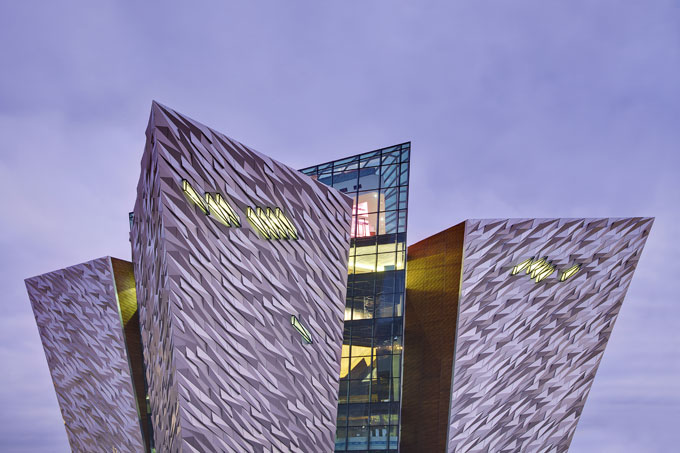
    But the size is really a secondary consideration. The building is a triumph of architecture, and it is now one of the main tourist attractions of Belfast. The outside of the building is lined with thousands of three-dimensional aluminum plates, the reflectiveness of which is enhanced by pools of water that surround the base of the building. The effect is even more pronounced because the outside facade leans out at a 25-degree angle. There are over three thousand aluminum panels, and two thousand of these have unique shapes. This creates a “startlingly random effect,” to use one of the promotional materials’ more inspired turns of phrase. Once inside the building, in the central atrium, you will be confronted by several long glass escalators. After you reach the top, you can begin to explore the Titanic.   

    Here is a picture of the building taken shortly before it was opened:

    Titanic Belfast

    Of course, a museum, however impressive it may look, is ultimately only as good as the educational experience it facilitates, and Titanic Belfast will not disappoint in this regard. The museum explores every aspect of the Titanic in extreme detail, from the very start of its construction to the undersea explorations of the wreck. In fact, it goes even beyond this, as there is a gallery about Belfast the city, that explains the cultural context in which the Titanic emerged, and there is also an Ocean Exploration Center attached to the museum that focuses on marine research and education. Since the museum was just built, the whole Titanic story is explained in a new and technologically advanced way, with interactive features, full-scale reconstructions, and so on.

    If you like museums and you are even vaguely interested in the Titanic, a visit to Titanic Belfast should be incorporated into any trip that takes you near Belfast.

  • The Titanic Cruise

    That the massive Titanic boat (which, as we never fail to point out, is actually a “titanic boat” in two senses) collided with an iceberg in the middle of the Atlantic Ocean, leading to the sinking of the Titanic and the deaths of over 1,500 people, is well known and much discussed. When people consider the Titanic, they tend to think of only the Titanic boat itself falling apart at sea and then sinking to the bottom of the ocean. This is the ship’s primary legacy. But it is important to keep in mind that the Titanic boat was a massive and luxurious cruise ship, not entirely unlike the cruise ships that exist today, and that got us thinking about what a Titanic cruise would have been like. How would, say, a Carnival cruise compare with a Titanic cruise? How similar is the Titanic cruise ship, if it even makes sense to call it the “Titanic cruise ship,” to modern-day cruise ships? Basically, would a Titanic cruise be comparable to a standard cruise vacation one might take today – if so, to what extent? – and did the Titanic boat have accommodations similar to cruise ships that are currently operating?

    With respect to the Titanic boat itself, it was basically structured in the same way that a modern cruise ship is structured. For one, the size is comparable. The Titanic was 882 and a half feet long (269 meters) and 175 feet (53.3 meters) tall (to the top of the funnels that line the ship), making it a large ship that weighed a little over 46,000 tons. It had a large capacity too: it was designed to hold well over 3,000 people (2,435 passengers and 892 crew members). The Titanic was the biggest ship in the world when it set sail on its maiden voyage, and even by today’s standards it is a large ship (although it is certainly no longer the world’s largest cruise ship.) The Titanic also had multiple decks that divided the ship into different levels, with each level having different facilities. This layout is basically the same on modern cruise ships.

    So in terms of size, the Titanic boat was a lot like a modern cruise ship, but what about the on-board accommodations a Titanic cruise would have offered? If you were a First Class passenger, your accommodations would have been somewhat similar to those offered on a modern cruise. In the First Class section, there was a swimming pool and gymnasium, along with luxurious rooms decorated with expensive furniture. So, the First Class passenger experience (and to a lesser extent the Second Class passenger experience) was a bit like vacationing on a modern cruise ship. However, First Class passengers had more elaborate rooms than your average cruise vacationer would have today, and today’s passengers have access to more on-board activities than even First Class passengers had on board the Titanic. On the other hand, most people who take cruises today wouldn’t be satisfied with being a Third Class passenger, who had access to only two bathrooms (one for women and one for men) and had to wash their own clothes using iron tubs. Also, many Third Class passengers were on the Titanic to relocate to the United States, and passengers on modern cruise ships generally don’t take them for transportation purposes.

    Overall, taking a Titanic cruise would have been in many ways comparable to taking a cruise today. The accommodations on board the Titanic weren’t nearly as extensive as they are today (especially for Third Class passengers), but the Titanic boat was still designed with an eye toward relaxation and leisure, just like modern cruise ships. Moreover, the Titanic boat itself was actually quite similar to today’s cruise ships. The Titanic was a large vessel with many decks, each with their own facilities, much like modern cruise ships.

  • The Titanic Location

    Where is the Titanic location? Well, that depends on what is meant by “Titanic location,” but there are at least four places of importance associated with the Titanic, all of which are the UK, the US, or, of course, somewhere in between (namely, the Atlantic Ocean). So, in this article, we will answer the following four questions: Where was the Titanic built? Where did the Titanic set sail from? Where did the Titanic sink, and by extension, where is it now? And finally, to what location was the Titanic sailing? These are all important Titanic locations, although the first and the third strike as particularly significant. Those are, as it were, the main Titanic locations.

    The Titanic was built in Belfast, which is the capital of, and largest city in, Northern Ireland. Historically, Belfast has been at the center of the shipbuilding industry, not least because of the presence of the shipbuilders Harland and Wolff. White Star Line, the company that commissioned the building of the Olympic class (which included the Titanic, as well as the Olympic and Britannic), had a longstanding commercial relationship with Harland and Wolff, which made them the natural choice of builders for the ambitious new line of ships White Star wanted to put into operation. Because of the work of Harland and Wolff, Belfast had the largest and most productive shipyard in the world in the early 20th century.

    The next place of importance is Southampton, which is located on the south coast of England. This is where the Titanic set sail from for its maiden voyage, which occurred on April 10, 1912. After the Titanic underwent sea trials to test its seaworthiness, it returned briefly to Belfast, and then set off for Southampton, which is about 660 miles (1,060 kilometers) away. The Titanic arrived at Southampton, which had recently built a special deep-water dock to accommodate the enormous ships in White Star’s new line, at about midnight on April 4. Although the Titanic was supposed to set sail from Southampton many times, it left only once.

    The place most commonly associated with the Titanic is of course the location where it sank on April 14, 1912. Late at night on the 14th, the Titanic was sailing through icy waters in the North Atlantic. The ship had received several iceberg warnings the night the Titanic sank, but the ship charged ahead at almost full speed, although at inquiries into the disaster captains of other ships claimed that there was nothing unusual about this. In any case, at 11:40 PM, the Titanic hit an iceberg 375 miles south of Newfoundland. In less than three hours, the Titanic sank. The wreckage lies in roughly the same spot off the Newfoundland coast where the Titanic hit the iceberg, but over 12,000 feet (3,700 meters) below the surface.

    The last important place linked to the Titanic is New York City, which the ship never reached. Many passengers on board the Titanic were immigrating to the United States. Had they successfully arrived, they would have went through Ellis Island, which was the busiest immigrant inspection station in the United States between 1892 and 1954. Millions of immigrants passed through Ellis Island, but, alas none of them arrived to the famous immigration point on board the Titanic.

    The most significant Titanic location, and the place most people think of when they reflect on the Titanic, is place where the ship sank. This is understandable, considering the Titanic probably wouldn’t be reflected upon at all had it not collided with an iceberg, a disaster that caused over 1,500 deaths. However, the other places mentioned are important Titanic locations that deserve to be remembered as part of the tragic story of the Titanic.

Skip to content